Image
Hazard
Landslides
Relatively rapid downhill movement of a mass of soil, rock, and other debris.
Relevant Options
Purchase backup generators for the water infrastructure system to provide a sustained minimal level of water services in the event of a catastrophic power loss.
Work with local planning departments to establish setback requirements that help prevent or prevent impacts from erosion or landslides. Use large setbacks
Create a plan for timely clean-up pre- and post-event to avoid impacts on natural areas and water bodies.
Create and invest in strategic pre-disaster plans for post-disaster recovery.
Prepare geohazard designation mapping. Use these maps to update zoning codes and building regulations.
Revise the community's steep slope ordinance to add other metrics beyond elevation and slope, such as density, land disturbance and tree removal prohibitions.
Assess governmental assets' exposure to erosion, extreme heat, flooding, high winds, landslides, severe winter weather and wildfire. Determine if those assets house critical functions. If they do, determine
Use a detailed analysis of landslide susceptibility when considering infill and development proposals. Consider the impacts of upslope and downslope debris flow pathways using shallow translational slopes
Set money aside to address hardening roads against landslides and erosion.
Develop a local funding mechanism (e.g., gas tax or tax increment financing) to provide dollars towards non-capacity transportation projects.
Locate funds to replant established trees, which offer stormwater management as well as cooling benefits during hot weather, after extreme weather disasters.
Offer financing incentives for landowners to apply soil stabilization measures, such as planting vegetation, on steep slopes.
Educate potential buyers on how to assess properties that may be located in high-risk landslide areas. Collaborate with erosion and landslide professionals to conduct workshops, develop brochures or launch
Require transportation access plan agreements for all large developments.
Use debris-flow measures that may reduce damage in sloping areas, such as stabilization, efforts to spread or dissipate the force and flow control measures.
Plan to relocate critical facilities in high-risk areas using a frame in line with their expansion or refurbishment cycles.
Create a map of detours and educate the public on alternative access points and the evacuation plan. Ensure drafted communications include instructions on preparing to be temporarily stranded.
Restrict or limit activity that would strip slopes of essential topsoil.
Integrate erosion and landslide risk hazard mitigation into program administration activities such as your community’s comprehensive plan, land use plan, agency or department strategic plans and program
Conduct an outreach program that educates the public on the dangers of removing natural vegetation from dunes and slopes near buildings and infrastructure.
Related Case Studies & Action Plans
Image
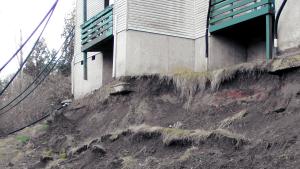
This photo has been released into the public domain because it contains materials that originally came from the U.S. Army Corps of Engineers. No endorsement by licensor implied.
Image
Photo attributed to Royalbroil. Incorporated here under the Creative Commons Attribution 3.0 Unported license. No endorsement by licensor implied.